Something changed this week.
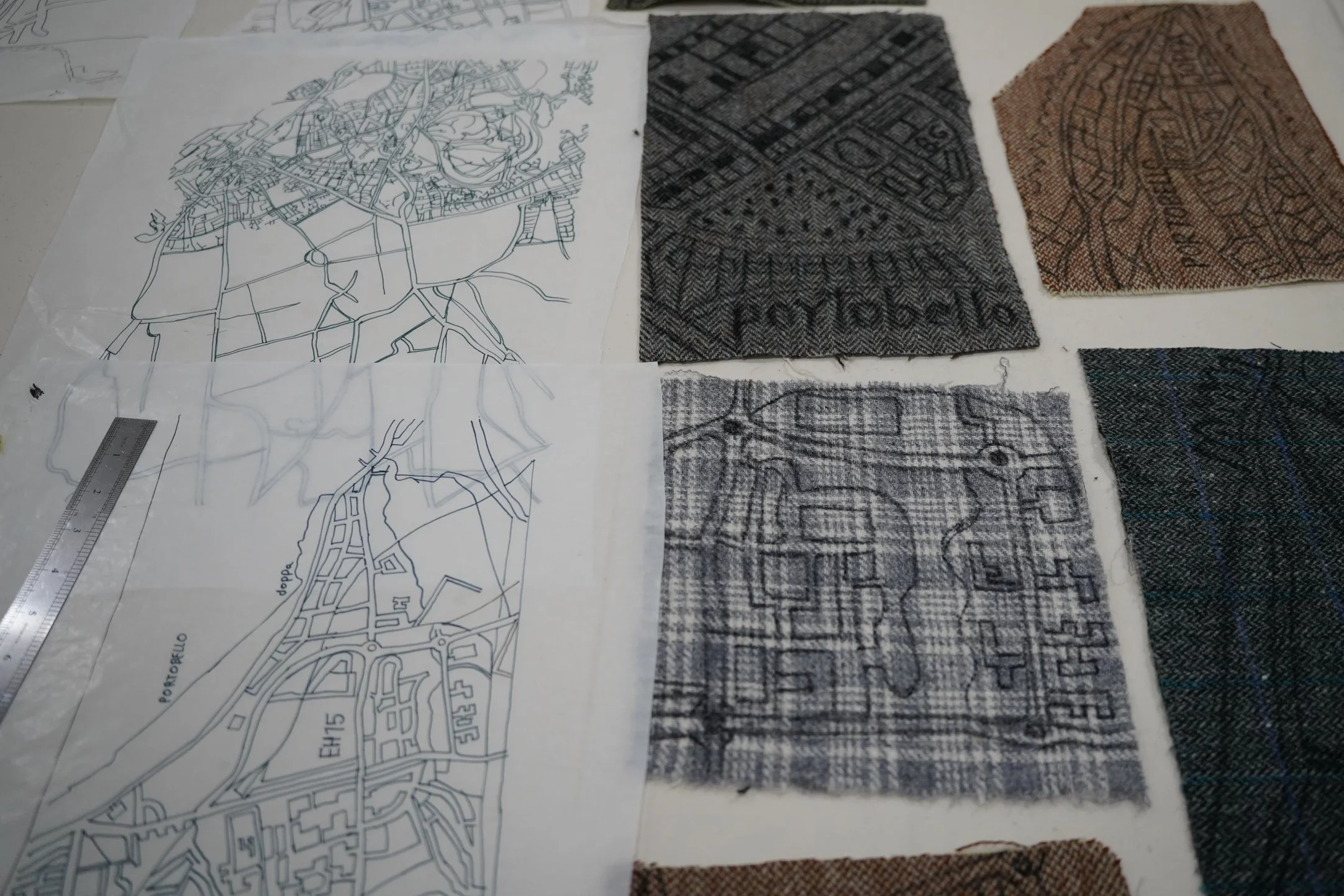
Until now, the maps have mostly lived in books, on tracing paper, in my notebook, or in my head — as routes, fragments, old road structures, remembered turns. But here, for the first time, they begin to land on Harris Tweed.
Not perfectly, and not yet permanently. Which is exactly why it feels exciting.
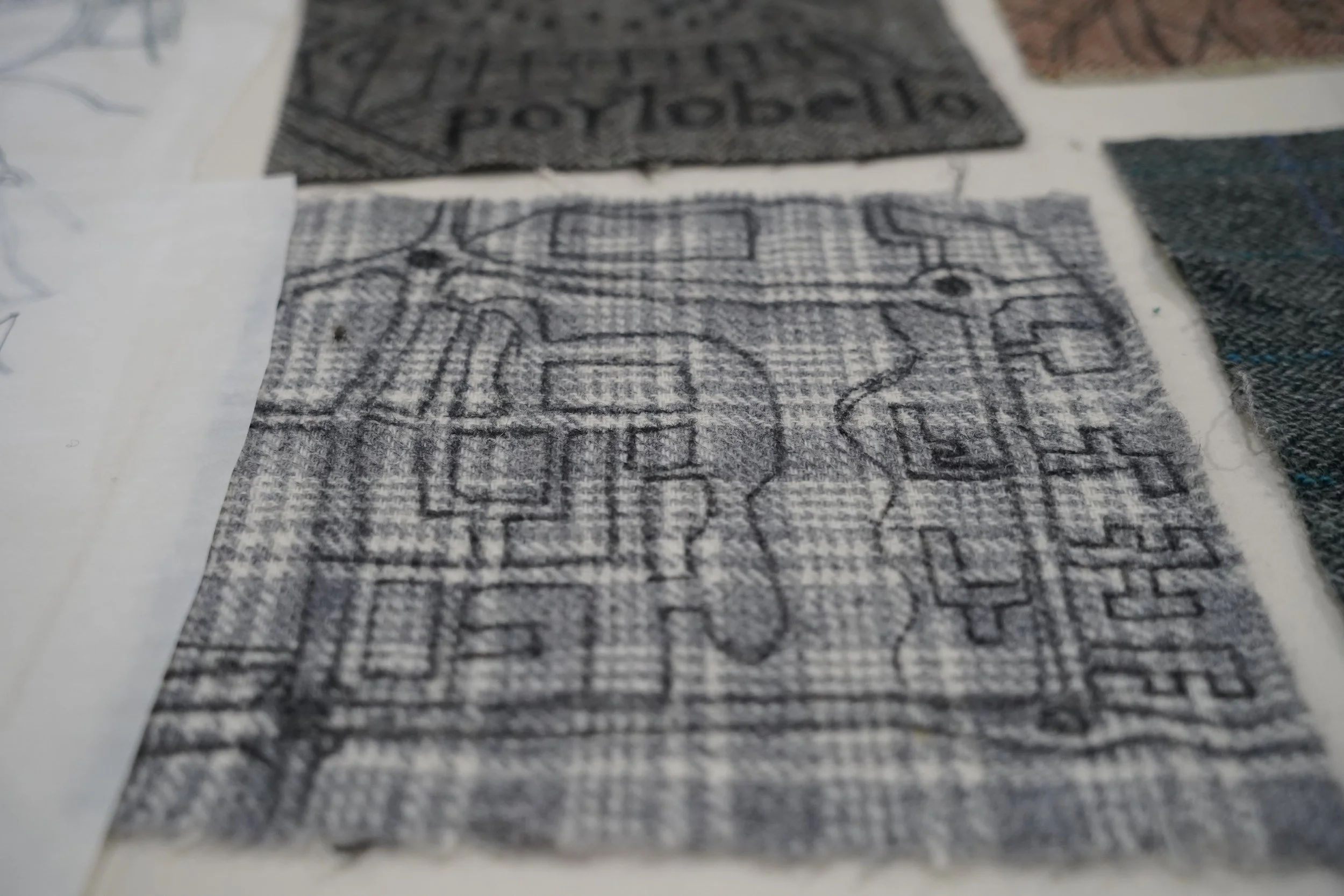
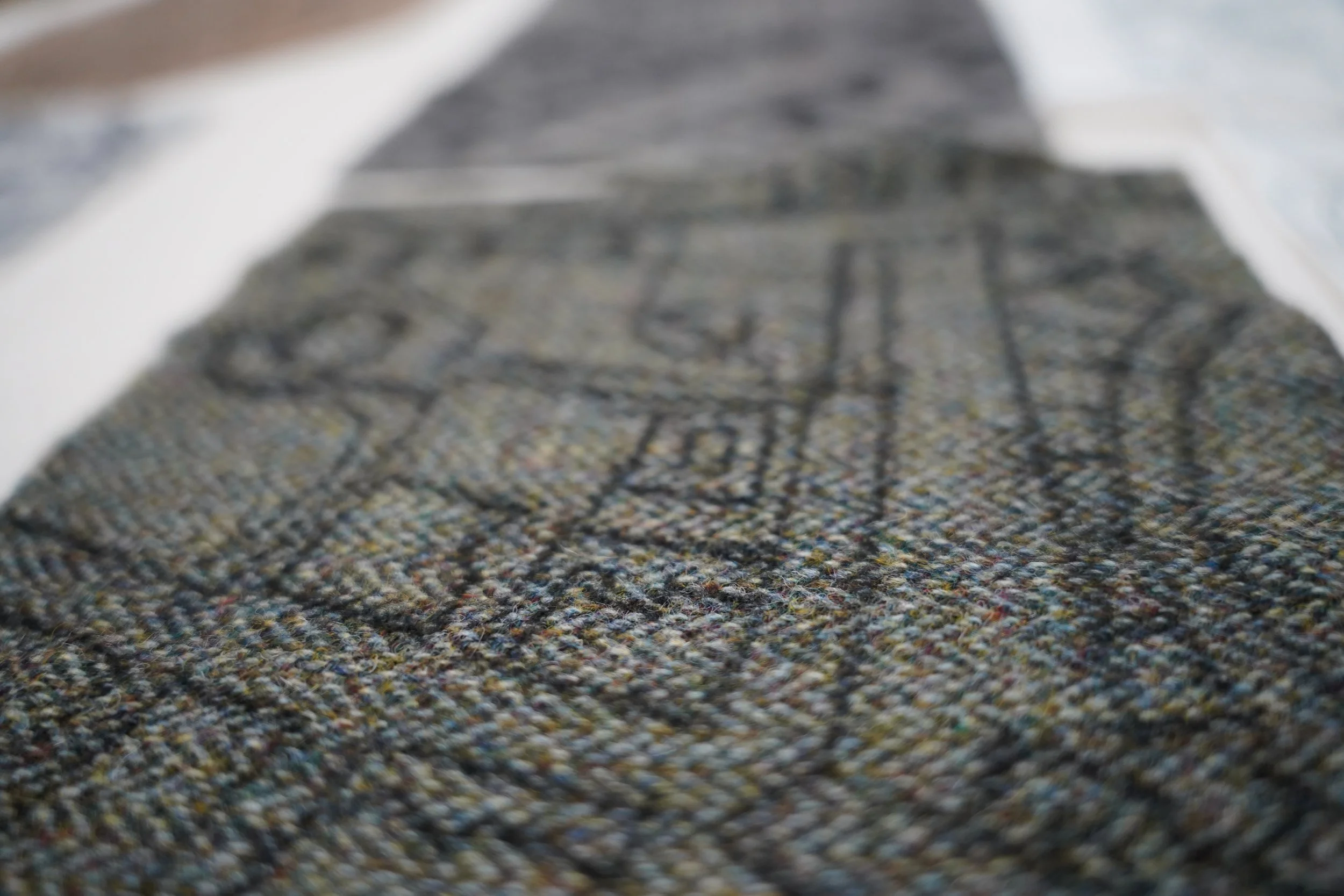
I’ve been testing what happens when parts of Edinburgh — and more specifically Portobello, Joppa, and the older structures around them — are translated onto tweed samples. Some of the cloths are grey and restrained, almost stony. Others carry more movement in their weave: flecks of green, blue, brown, a kind of weather already built into the surface. What interests me is how differently each one receives the same line.
A road on paper behaves one way.
A road on wool behaves another.
On some samples, the map feels almost absorbed into the cloth, as if it had always been there waiting to surface. On others, the lines sit more sharply, more graphically, closer to print culture, closer to signage or plan-drawing. And then there are moments where the weave starts arguing back — the herringbone redirects the eye, the check interrupts the grid, the softness of the cloth pulls the geometry slightly off its authority. I like that. I don’t want the map to arrive as pure control. I want it to be altered by material.
That, I think, is the real proposition here: not simply printing or drawing maps onto tweed, but allowing cartography to become textile.
Some of these tests carry labels — Edinburgh, Portobello — and I’m noticing how text changes once it sits on wool. It loses some of its neutrality. It becomes less like information and more like a voice. Elsewhere I’ve been placing fragments of older plans alongside contemporary route systems, letting different versions of the city overlap without fully resolving into one image. The cloth begins to hold multiple times at once: old roads, current infrastructure, walking memory, planned line, woven structure.
What’s exciting is that these are not “designs” yet. They’re closer to proofs of feeling. Small negotiations between surface and system.
The strongest samples so far are the ones where the map doesn’t dominate the tweed and the tweed doesn’t swallow the map. They meet somewhere in between. The line remains legible, but softened. The cloth stays itself, but becomes newly readable.
That feels close to what I’ve been looking for from the beginning.
A map, yes — but one held by weather, labour, and touch.