
A research journey into wool, value, and small-scale textile futures
Wool Futures Studio is a research and development project by Twilling Tweeds, supported by Creative Scotland’s Go See Share fund. The project explores how wool moves from raw material into cultural, ecological and commercial value. Through a short research visit to Norway, Twilling Tweeds is examining how Norwegian wool is collected, graded, processed, designed with, and positioned within contemporary textile markets.
At the heart of the project is a simple but urgent question:
How can a small design-led wool studio build a more resilient, meaningful and commercially viable future around wool?
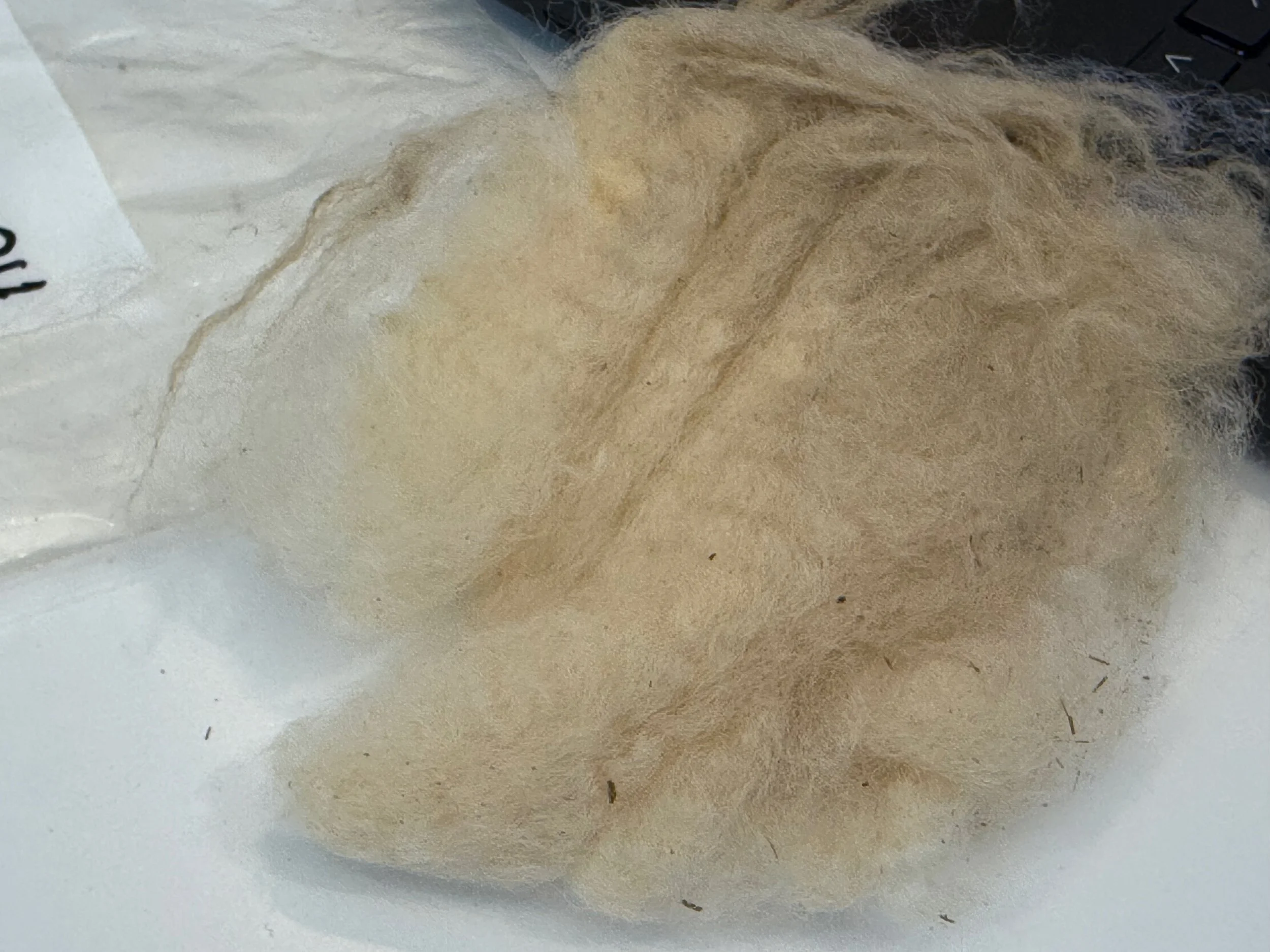
Raw wool carries weather, animal life, vegetation, labour and place before it ever becomes cloth.
About the Research
Twilling Tweeds has always worked with wool as more than a material. Wool carries landscape, labour, memory, climate, animal life, language and inherited skill. From Harris Tweed in Scotland to Chitrali Shu in northern Pakistan, the studio’s work is rooted in the belief that cloth can hold stories of place, movement and belonging.
Wool Futures Studio builds on this foundation by looking more closely at the systems that allow wool to be valued — not only emotionally or culturally, but also practically and commercially.
Norway offers an important case study. Its wool sector has developed strong systems around classification, grading, farmer support, production, design, and national identity. While Twilling Tweeds is not seeking to replicate Norway’s model, the project asks what principles can be translated into a smaller, independent studio context.

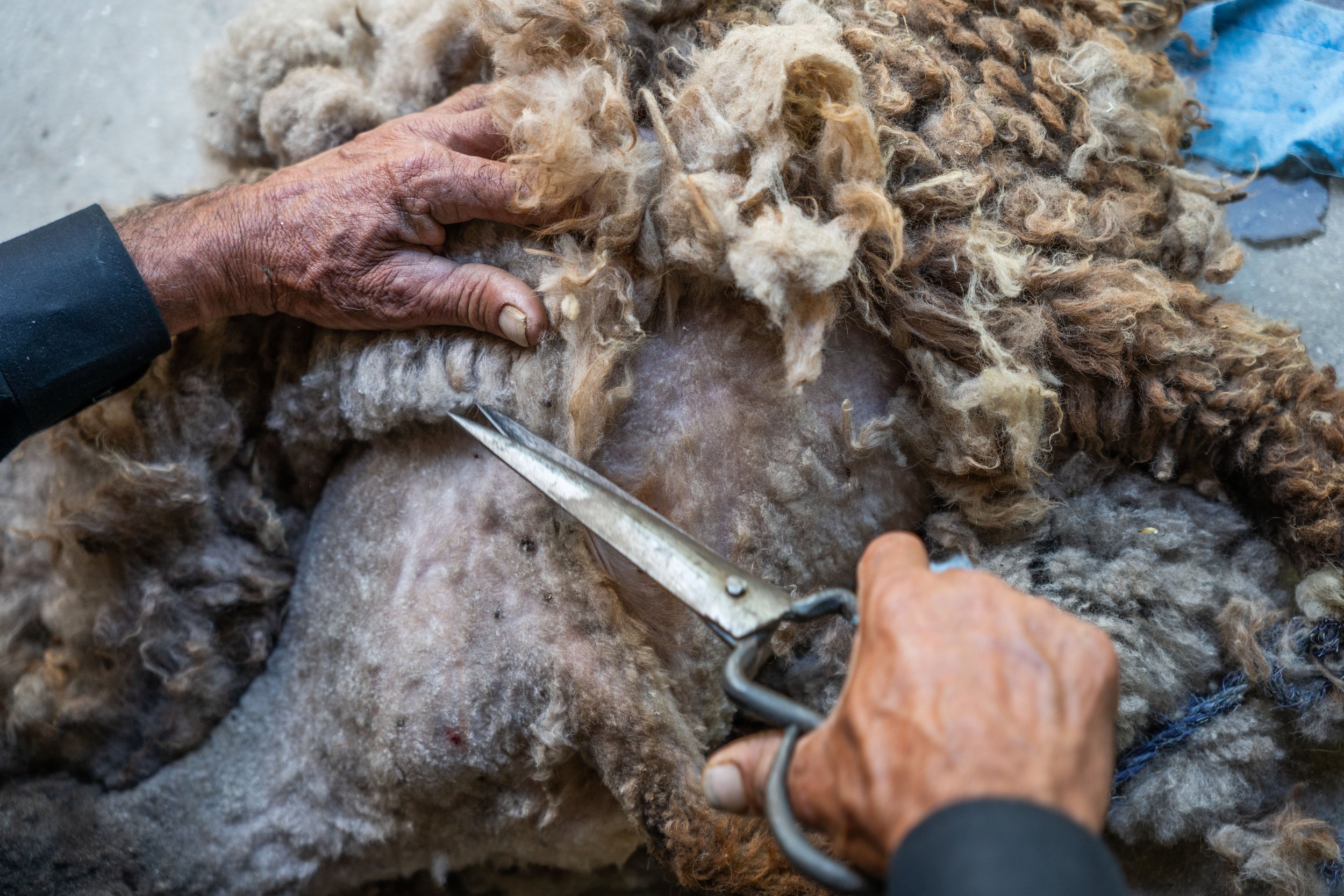
The shears mark the first threshold in the wool journey: where fleece leaves the animal and enters the world of making.
Field Visit to Norway
In Norway, Adil Iqbal is meeting wool specialists, curators, mills and textile organisations to understand how wool becomes legible: how it is named, graded, trusted, designed with and positioned in contemporary markets.
The research includes conversations around:
Norwegian wool grading and classification
the role of wool standards in building trust and value
small-scale and industrial wool production
contemporary uses of Norwegian wool in design, interiors, clothing and craft
museum collections and textile archives
how local wool can be positioned within high-quality contemporary practice
what small textile studios can learn from organised wool systems
These encounters are helping Twilling Tweeds think more deeply about how wool becomes legible: how it is named, sorted, described, trusted, and ultimately transformed into objects of value.
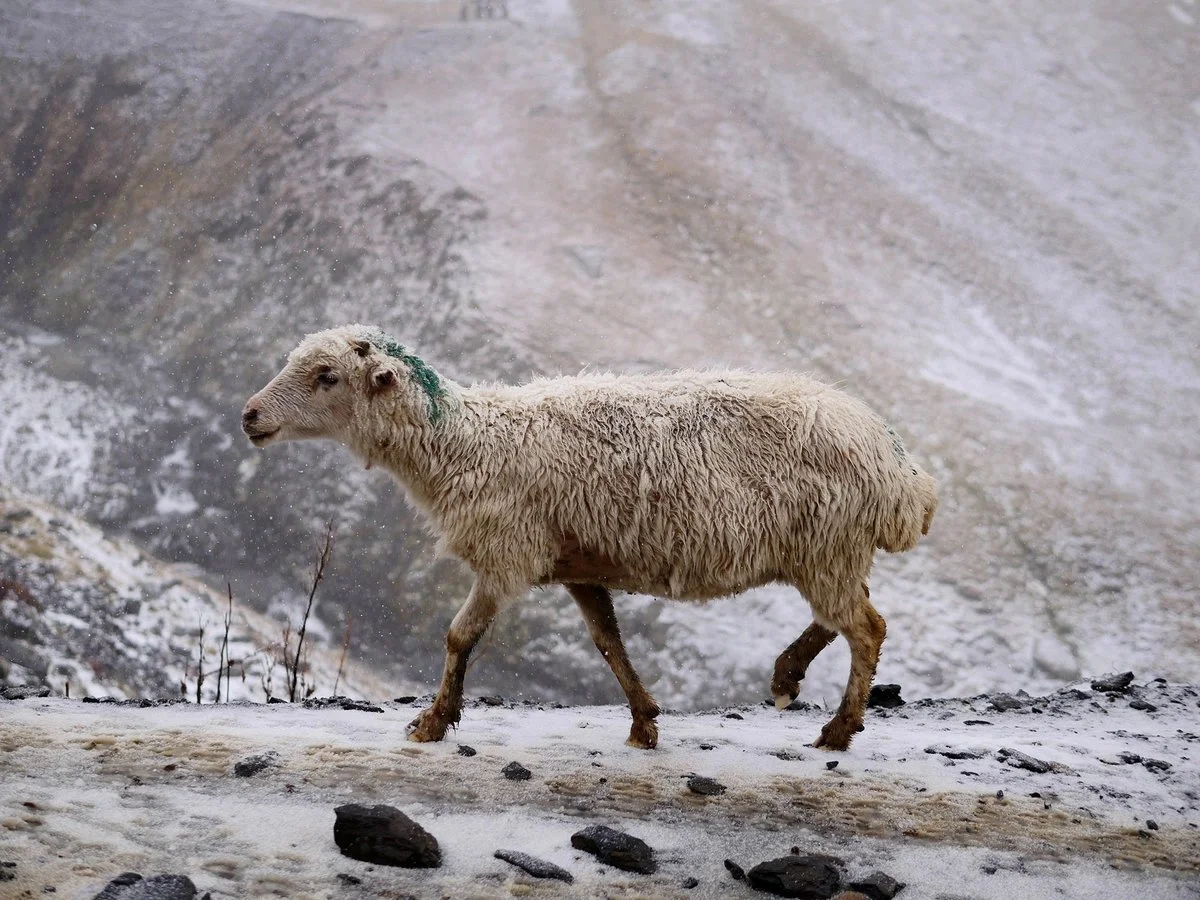
Norway offers a case study in how wool can be supported through agriculture, grading, industry and design.
Why Norway?
Norway’s relationship with wool is both practical and cultural. Wool is not treated only as a nostalgic material, but as part of a wider system of agriculture, design, industry and national identity.
This is particularly relevant to Twilling Tweeds as the studio develops its next phase: moving from project-led work towards a clearer studio model built around commissions, limited editions, research, and material-led consultancy.
For Twilling Tweeds, the lesson is not about scale. It is about structure.
A small studio does not need to become industrial in order to become sustainable. But it does need clarity: around materials, production, pricing, storytelling, and the specific value it offers.
What the Project is Developing
Wool Futures Studio supports Twilling Tweeds to refine its future direction as a small, premium, design-led wool studio.
The project is helping shape:
a clearer commission model for bespoke textile works
new approaches to pricing and material value
a stronger language around wool quality, origin and use
future limited-edition textile works
deeper relationships with mills, makers, curators and wool specialists
public writing and sharing around wool, craft and textile futures
The research also contributes to the studio’s wider work connecting Scotland and Pakistan through wool, embroidery, pastoral knowledge and contemporary textile art.
Sharing the Learning
As part of the project, Twilling Tweeds will share reflections through field notes, writing, talks and online resources. These will be aimed at artists, designers, makers, small studios, researchers and anyone interested in wool as a material of both cultural and economic possibility.
Rather than offering a fixed blueprint, Wool Futures Studio shares an evolving set of questions:
How do we make wool matter again?
How do we value materials without flattening their histories?
How can small studios work with slowness, depth and quality while still building viable futures?
What forms of knowledge are held in cloth, and what systems are needed to help that knowledge survive?
Towards a Wool Future
Wool Futures Studio is part of Twilling Tweeds’ ongoing commitment to cloth as a living archive — a place where landscape, memory, skill and imagination meet.
The project marks an important step in the studio’s development: from a body of beautiful textile projects towards a more defined and sustainable studio practice.
It is a journey into wool not only as fibre, but as future.
Supported by Creative Scotland through the Go See Share fund.
Field Note 1: Wool as System
How wool becomes legible
Wool is often spoken about as if it begins with softness.
Softness, warmth, comfort, nostalgia. These are the words that gather quickly around it. They are not wrong, but they are incomplete. Wool is also structure. It is classification. It is trust. It is a material that passes through systems long before it becomes a garment, a cloth, a wall work, a blanket, a cloak, or an object of value.
During my research visit to Norway, supported by Creative Scotland’s Go See Share fund, one of the most important conversations took place at Animalia, the Norwegian Meat and Poultry Research Centre, with Siv, whose work connects directly to the Norwegian wool system.
What stayed with me was not only the technical information, but the clarity of the thinking. Norwegian wool is not treated as a vague or generic substance. It is named. It is sorted. It is graded. It is assessed in relation to quality, use and value.
This matters.
Because when wool is named properly, it becomes easier to trust.
When it is sorted carefully, it becomes easier to use.
When it is understood materially, it becomes easier to value.
The standard behind the fibre
The Norwegian Wool Standard offers a way of reading wool. It recognises that wool is not one thing. It changes according to breed, season, colour, length, strength, crimp, lustre, vegetable matter, medullation, cleanliness and suitability for use.
A fleece is not simply “good” or “bad.” It has characteristics. It has a future use. It has a place within a wider material economy.
This was one of the strongest lessons from Animalia: wool becomes more valuable when there is shared language around it.
For farmers, grading can affect price and recognition.
For mills, it creates consistency and confidence.
For designers, it offers material intelligence.
For the wider market, it helps build trust.
A material cannot travel well if no one knows how to describe it.
Wool as connection
Norway’s wool system cannot be copied directly into the context of Twilling Tweeds, Scotland or Chitral. Nor should it be. The point of this research is not replication. It is translation.
What Norway offers is a way of seeing wool as a connected system.
Wool is connected to agriculture.
To sheep breeds.
To landscape.
To weather.
To shearing.
To collection.
To grading.
To mills.
To design.
To national identity.
To end use.
To price.
To trust.
This changes how I think about my own work.
For years, I have worked with wool through memory, landscape and cultural exchange: Harris Tweed in Scotland, Chitrali Shu in northern Pakistan, embroidery, pastoral knowledge, archive and textile art. These materials carry deep stories, but stories alone are not enough. The challenge now is to build a clearer material language around them.
What kind of wool is being used?
What does it do?
What does it hold?
How does it behave?
Why is it suitable for this particular work?
What makes it valuable?
What knowledge sits behind it?
These questions are not separate from the poetry of cloth. They protect it.
From romance to structure
One of the dangers with wool is that it can become trapped in romance.
We speak of sheep, mountains, hands, old ways, warmth and slowness. These things matter deeply. But if wool is only romanticised, it remains vulnerable. It becomes easy to admire, but difficult to price. Easy to celebrate, but difficult to sustain. Easy to photograph, but difficult to build a future around.
The Norwegian example reminded me that affection is not enough. Wool needs structure.
It needs systems of care.
Systems of description.
Systems of quality.
Systems of making.
Systems of use.
Systems of value.
For Wool Futures Studio, this is a crucial shift. The aim is not to make wool less emotional. It is to give emotion a framework. To make sure that beauty is supported by clarity, and that material depth can become commercially and culturally legible.
What this means for Wool Futures Studio
Wool Futures Studio is beginning to build its own material vocabulary.
This will not be a formal grading system like the Norwegian Wool Standard. It will be something more intimate and studio-based: a way of describing the materials that sit at the heart of my practice.
Harris Tweed may be understood through structure, durability, Scottish wool heritage and woven identity.
Chitrali Shu and patti may be understood through pastoral memory, handwoven surface, mountain knowledge and endangered craft skill.
Embroidery may be understood as drawing, mapping, repair, inscription and surface intelligence.
Raw wool may be understood as origin: animal, weather, vegetation, season and care.
Felted wool may be understood through pressure, water, heat, touch and transformation.
Each material carries a different kind of knowledge. Each asks to be used differently.
The work now is to make this knowledge visible: through samples, writing, commissions, field notes, talks, photographs and a growing material library.
Legibility as care
To make wool legible is not to make it cold.
Legibility can be a form of care. It allows a material to be understood without flattening it. It gives language to the work of farmers, shearers, graders, spinners, weavers, embroiderers and designers. It helps clients and audiences understand why something takes time, why it costs what it costs, and why certain materials matter.
This is especially important for small textile studios. Without clear language, the value of the work can disappear into vagueness. The labour becomes invisible. The material becomes decorative. The research becomes background.
Wool Futures Studio is trying to resist that.
It is asking how a small, research-led wool practice can build a future through material intelligence, not just beautiful objects.
The lesson from Norway
The lesson I am carrying from Animalia is simple, but important:
Wool survives when it is not only loved, but organised.
It survives when people know what it is.
When they know how to sort it.
When they know how to speak about it.
When they know what it can become.
For Twilling Tweeds, and for the emerging Wool Futures Studio, this is the work ahead: to move from project-led making towards a clearer studio model, where wool is understood as fibre, story, system and future.
Not only soft.
Not only old.
Not only beautiful.
But legible.
Trusted.
Held.
Used.
Valued.
Wool as system.
Wool as memory.
Wool as future.
Supported by Creative Scotland through the Go See Share fund.
Field Note 2: Lillehammer, the mill, and what a small studio can learn from scale
There are moments in a research trip when an idea stops being abstract and becomes spatial.
Lillehammer was that moment.
Up until then, Norway had been teaching me through conversations: through policy, grading, standards, institutional memory, and the subtle architecture that allows wool to remain legible in public life. But a mill changes the register. A mill does not speak in theory alone. It speaks in sequence, proximity, pressure, and process. It reminds you that textiles are not made by concept; they are made by decisions. A raw material becomes a product only because someone, somewhere, knows how to move it through a chain without losing coherence.
That is what Gudbrandsdalens Uldvarefabrik clarified.
GU has produced wool textiles in Lillehammer since 1887, and what makes it especially striking is that it remains vertically integrated: the processes from raw material to finished textile are kept under one roof, with design, development, and production in close relation to one another. The company describes itself as the only vertically integrated manufacturer of designer textiles in Scandinavia, and says this proximity allows control over the value chain, high flexibility, and strong quality outcomes.
That phrase — control over the value chain — stayed with me.
Not because Twilling Tweeds should try to become a mill. It should not. But because it forces a more useful question: if I cannot control the full chain, which parts of it do I need to understand deeply enough to build a viable studio around?
1. Wool becomes value through sequence
One of the most important lessons from GU is that good textiles are not simply beautiful materials. They are the result of a disciplined sequence: idea, material choice, binding structure, development, testing, adaptation, finish, performance. GU’s own production language emphasises that before a textile reaches the market it moves through design, technical construction, development and testing, with product development and material understanding tightly connected.
This matters enormously for Twilling Tweeds.
The studio has depth, image language, research, and cultural intelligence. But one of the clearest risks in a small creative practice is that material beauty can be mistaken for product readiness. A strong image is not yet a strong offer. A compelling story is not yet a resolved textile. The lesson of GU is that value is built not only in inspiration, but in resolution.
For Twilling Tweeds, that means moving more decisively toward:
clearer development pathways
a better understanding of where technical performance matters
stronger awareness of what makes an object or textile commercially credible
and a sharper distinction between what is an artwork, what is an interior object, and what is a scalable product
2. The product is not the cloth alone — it is the fit between cloth and market
GU’s world is not built around a generic idea of wool. It is built around appropriate end use. The mill specialises in woollen fabrics for furniture and upholstery, but also works across transport, bunad cloth, and selected clothing applications. It produces around 600,000 metres of textile annually and supplies sectors ranging from interiors to buses, trains, cruise ships, bunad, and footwear.
This is a useful correction.
It shows that even a wool-focused company does not survive by saying “we make wool textiles.” It survives by saying:
this wool is right for this use
this fabric performs in this environment
this textile belongs to this market
That fit is where the business becomes real.
For Twilling Tweeds, the strategic implication is clear:
the studio needs to stop treating all outputs as one broad field of “wool work,” and instead become more specific about its own categories.
That may mean clearly separating:
commissioned textile wall works
interior-facing textile objects
collectible limited editions
research-led or exhibition-led textile projects
consultancy / material direction
Those are not the same offer. They require different language, different clients, and different price logic.
3. Scale is not the lesson — coherence is
It would be easy, and wrong, to come away from GU thinking that the lesson is to build bigger. It is not.
The lesson is coherence.
GU is strong because design, production, and use are tied together. Its longevity is not accidental; it comes from a clear relationship between:
raw material
design development
technical expertise
customer sector
and product life
The studio scale of Twilling Tweeds is obviously very different. But coherence still applies.
Twilling Tweeds does not need industrial scale. It needs:
clearer pathways from idea to offer
stronger confidence about what belongs where
better articulation of why its wool-based work matters in specific contexts
and less diffusion between research, experimentation, and revenue
In that sense, GU does not provide a model to copy. It provides a principle:
a studio becomes viable when its internal logic is strong.
4. Norwegian wool works when it is translated into contemporary relevance
GU’s recent history is also telling. The company notes that between 2014 and 2016 Norwegian wool was brought back into production more substantially, including a separate collection in 100% Norwegian wool developed with Flokk and Sandnes Garn. They also note that much of the work lay in getting Norwegian wool clean enough and appropriate enough to function in furniture textiles. Over time, Norwegian wool was reintroduced wherever possible across upholstery and furniture cloth.
That is a powerful lesson.
It means local wool did not automatically return because of sentiment. It returned because someone did the hard work of:
adapting it
cleaning it
developing it
proving it
and positioning it in a contemporary context
This is deeply relevant to Chitrali Shu and to the future of Twilling Tweeds.
If a local wool system or cloth tradition is to live again, it cannot be carried only by romance. It has to be translated into forms, functions, and markets that make sense now. That is not betrayal. It is how continuity happens.
For Twilling Tweeds, that might mean asking harder questions such as:
which parts of Chitrali cloth culture belong in collectible art practice?
which parts could become interior commissions?
which parts could live in highly controlled small editions?
and which parts should remain in the realm of cultural or archival work, rather than being forced into product?
5. The future may lie in premium smallness, not broad growth
Another striking point in GU’s references is the way wool enters contemporary life through very different collaborations: upholstery for Stressless, train interiors for NSB, and the official 2026 Olympic shoe with Alfa using textile made from 100% Norwegian wool. In each case, the material is not sold as nostalgia. It is sold as quality, performance, durability, and contemporary relevance.
Twilling Tweeds is not moving toward transport textiles or industrial supply. But the strategic insight still matters: wool holds value when it is placed within a believable, high-quality context.
For Twilling Tweeds, that suggests a future not of broad retail, but of premium smallness:
fewer things
better resolved
more authored
more materially specific
more clearly matched to the right audience
That may be the path:
not more volume, but more precision.
6. Lillehammer also sharpened the cultural frame
The day’s second layer came through Maihaugen. There, the exhibitions Impulses and Hunting the Hekne Weave place Gudbrandsdalen’s tapestry tradition within a long history of wool, linen, storytelling, and domestic display. The Hekne exhibition foregrounds iconic regional tapestries, legends of women weavers, and a textile culture in which cloth is not separate from memory, celebration, or narrative transmission.
This mattered because it created a bridge between production and inheritance.
The mill showed how wool becomes viable in the present. The museum showed how cloth carries time.
And for Twilling Tweeds, that pairing feels especially close to home. The studio is not only interested in wool as product. It is also interested in wool as story, object, and cultural residue. That is where it sits — between contemporary design and remembered worlds.
The danger, of course, is getting trapped there: becoming all atmosphere, all memory, all reference. Lillehammer suggests a better possibility. It suggests that the strongest textile practices may be those that can move between:
archive and market
utility and beauty
technical discipline and cultural resonance
What this means for Twilling Tweeds
Strategic learning
The Lillehammer visit suggests that Twilling Tweeds should think less like a loose creative practice and more like a small premium studio with a defined internal logic.
That means:
1. Clarify the offer
Be precise about what the studio makes:
bespoke wall works
interior commissions
limited editions
research-led collaborations
material consultancy
2. Build a product/commission ladder
Not everything should live at the same level. Some things remain unique commissions. Some become editions. Some stay as high-level artistic or institutional projects.
3. Strengthen development thinking
A beautiful textile idea still needs development, testing, finish, and contextual fit. The question is no longer only “is this evocative?” but also “is this resolved?”
4. Lean into premium positioning
Twilling Tweeds is not a mass-market proposition. Its strength lies in rarity, authorship, wool intelligence, and the ability to connect material depth with visual and emotional presence.
5. Understand end use more sharply
Every material does not belong in every object. Good strategy begins by asking what a cloth or wool surface is truly good at.
Field note 3 : Meeting with Siv / Animalia, Oslo
The meeting with Siv was one of the most important of the trip so far because it moved wool out of the realm of vague heritage and firmly into the realm of system, policy, classification, and value.
What became clear very quickly is that Norwegian wool does not survive simply because people love wool. It survives because it is held within a structure: governmental support, grading systems, long-term agreements, a shared industrial language, and institutional continuity. Wool here is not only cultural — it is administratively legible.
Siv herself occupies a fascinating position inside that structure. Although Animalia is a private organisation, her role is funded by the Norwegian government. That fact alone says so much. It means wool is not being treated as a leftover by-product of agriculture, but as something worth managing, protecting, and thinking about at policy level.
Key factual insights
The Norwegian wool support system has roots going back to the late 1940s and early 1950s.
The wool agreement dates to 1947.
Government support for wool has been in place since around 1952–53.
Animalia itself is a research and advisory body, and Siv’s role is state-supported through the agricultural department.
Norway protects its agricultural system strongly, partly because of climate and geography, and because local production of certain staples remains strategically important.
Wool support now goes primarily to farmers, not directly to industry, due to European trade agreements and the constraints of not being able to subsidise industry in the same way.
The wool is collected through a system of stations. Siv explained that there are 11 wool stations in Norway:
Norilia runs 8
Fatland runs 2
and one is very small
Norway reduced its wool classes from 70 quality types to 16 quality classes, because the industry no longer needed such a complicated system.
The wool itself
One of the most useful parts of the meeting was understanding that Norwegian wool is not one single thing. It is divided into three broad wool types, each with different properties and uses.
1. Crossbred / Norwegian white sheep wool
This makes up the majority — around 80% of the total.
Diameter: roughly 26–35 microns
Mostly undercoat / bottom wool
Strong, elastic, with what Siv described as a good “memory”
Holds shape well in use
Highly suited to robust garments, knitwear, shoes, woven products, and national costume cloth
2. Spæl wool
This is more complex, because it has:
very fine underwool
longer outer hair
lustre / shine
strong visual and tactile character
This feels especially relevant because it suggests a wool type that carries both beauty and material distinction. It is also more structurally layered than the white sheep wool.
3. Pels wool
This is curlier, more fleece-like, and visually striking.
More niche
Smaller percentage of the overall wool economy
Popular for fleeces, decorative use, and special products
What counts as “good wool”
Siv’s explanation of quality was extremely useful because it gave technical shape to the idea of value.
Good wool, in this context, means:
fibre diameter under a certain threshold
low medullation
little felting
low vegetable matter
good shine
strong crimp / elasticity
strength
whiteness / lack of discolouration
for pels wool, good curls
This was such an important reminder: value is not abstract. It is material, measurable, and closely tied to suitability for end use.
Microns and comparison
Siv explained the micron system very clearly:
Merino is often around 18–25 microns
Norwegian wool is often around 30 microns
That means Norwegian wool is generally coarser than Merino, but that does not make it inferior. It simply means it performs differently. It is stronger, more durable, and often better suited to products that need resilience and structure.
This feels very relevant to Chitrali wool too, which also tends to be robust, shape-holding, and not especially soft in the contemporary luxury sense.
End uses of Norwegian wool
The most useful insight here was that Norwegian wool is not only preserved symbolically. It is actively used.
Examples Siv mentioned:
national costumes (bunad) — more than half of the cloth used is now Norwegian wool
Røros Tweed blankets
Alpha shoes / mountain and hiking footwear
some yarns and baby clothing
sweaters and products made from undyed wool
increasing use in small spinning mills
This matters because it shows that Norwegian wool succeeds not by trying to become everything, but by finding strong, believable product categories.
Market pressure and current demand
One striking point: the most desirable grades are now sold out in Norway.
Siv explained that demand increased before COVID and rose significantly during it. People knit more, and in moments of crisis people often turn local. That meant Norwegian wool gained new momentum. Now the demand for the better classes is higher than the available supply.
This is a powerful observation:
good wool is not only surviving — it is becoming more desired.
Structural tensions
At the same time, the system is under pressure.
Siv noted:
overall wool value has not kept up properly with inflation
payment levels are still effectively too low compared to the past
the amount of wool is declining because there are fewer sheep farmers
support still needs to increase more substantially
wool not useful to large industry is often discarded
some categories have effectively fallen out of support or out of favour
This creates a tension:
the system is strong, but not secure.
It is protected, but also vulnerable.
Bradford and the washing problem
A particularly interesting point for the bigger value-chain picture:
most Norwegian wool is still sent to Bradford to be washed
Norilia owns Curtis Wool there
smaller companies or competitors also wash in England or Poland
only a few Norwegian producers have small local washing capacity
This means that even in a country with strong wool infrastructure, there are still critical bottlenecks and dependencies outside the country.
The rise of small spinning mills
One of the most hopeful parts of the conversation was hearing that more small spinning mills are now appearing in Norway.
These small producers:
often use wool the bigger industry is less interested in
often use undyed wool
sometimes wash their own wool
are creating a different, smaller-scale contemporary market
This is possibly one of the most useful lessons for Twilling Tweeds.
What this means for Twilling Tweeds
1. Wool needs structure, not only romance
The biggest lesson from Siv is that wool does not hold value by heritage alone. It holds value when there is:
classification
shared language
trust
end-use clarity
and policy or market structures around it
For Twilling Tweeds, that means:
you do not need to create a national system, but you do need to make your material world clearer.
Business implication
Twilling Tweeds should articulate more clearly:
what kinds of wool it works with
what those materials are best for
how they differ
why a client should care
This is part of building trust.
2. Different wool = different futures
A crucial insight from the meeting is that not all wool should become the same thing.
Different fibres suit different outcomes:
soft / skin-near products
durable garments
blankets
woven cloth
decorative applications
artistic objects
Business implication
Twilling Tweeds should not treat wool as a single aesthetic theme. It should divide its own offer into clear material and product categories.
For example:
wool for wall works
wool for interior commissions
wool for collectible textile editions
wool for collaborative or design-development projects
This helps move the studio from poetic wool language into real product logic.
3. Robust wool can be premium
Siv’s meeting was a good corrective to the contemporary obsession with softness.
Norwegian wool is not trying to compete with Merino by being ultra-soft. It holds value through:
strength
resilience
memory
shape
durability
suitability
This is deeply useful for Chitrali Shu and related cloth traditions too.
Business implication
Twilling Tweeds should lean into:
structural integrity
cloth memory
durability
hand-feel as character rather than softness alone
This opens up a more intelligent premium language.
Instead of:
soft luxury
the studio could emphasise:
grounded luxury, durable beauty, cloth with memory, wool with structure
4. The most important thing may be “fit”
One of the clearest lessons from the Norwegian system is that value comes from matching wool to the right use.
Business implication
Twilling Tweeds needs to become better at asking:
What is this material best at?
What kind of object suits it?
What kind of market suits that object?
This matters especially if you are thinking about:
wall art
healthcare commissions
interior textiles
collectible cloth pieces
even future collaborations with mills or studios
5. Government support matters — but you are not building that
Another big lesson is that Norway’s wool system survives partly because it is protected, subsidised, and politically legible.
Twilling Tweeds cannot replicate that. Nor should it try.
Business implication
The relevant takeaway is not:
build a Norwegian model in Scotland or Pakistan
The takeaway is:
identify which parts of this system can be translated into a small premium studio model
For Twilling Tweeds, that likely means:
stronger language
clearer categories
better alignment between material and offer
confidence in robust wool as a premium material
smaller, sharper, authored outputs
6. Small mills are especially important
The rise of small spinning mills in Norway may be one of the most useful insights of the whole trip.
These mills:
use less conventional wool
embrace undyed and local material
create niche value
work at smaller scale
Business implication
This aligns strongly with your own scale.
Twilling Tweeds should not imagine itself as a mass-market textile company.
It should think more like:
a small-scale premium wool studio
working through carefully chosen materials
with limited but highly intentional outputs
perhaps in future relation to niche mills, specialist washing, or small production partnerships
What struck me most in meeting Siv was that Norwegian wool survives not only because it is loved, but because it is organised. It is named, graded, defended, and linked to use. Wool here is not left to drift as sentiment — it is held within a system.
The lesson was not that Norway has solved wool, but that it has made wool legible. That may be one of the great differences between a material that survives and one that quietly disappears.
Field Note 4 : Norilia — value chain, infrastructure, and what a studio can learn from systems
If Siv clarified how wool becomes legible through grading, Norilia clarifies how wool becomes a market.
That distinction matters.
Grading explains value at the level of fibre. Norilia explains value at the level of infrastructure, throughput, sorting, customer relationships, and end use. Norilia says it handles nearly 80% of Norway’s annual wool clip, with eight grading stations around the country where every fleece is manually assessed according to the Norwegian Wool Standard. It also states that Norway’s annual clip is more than 4,000 tons.
That is not a niche craft operation. It is a national-scale system.
And that matters for Twilling Tweeds not because the studio should imitate it, but because it reveals a crucial principle:
materials do not become economically meaningful on their own — they become meaningful because someone builds the routes through which they can move.
1. Norilia’s role: not just selling wool, but organising flow
Norilia describes itself as a wholly owned subsidiary of Nortura, focused on creating value from “plus-products” and co-streams from the meat and egg industry. Wool sits inside that wider logic: not as a romantic heritage sector, but as a structured material stream that must be collected, graded, sorted, sold, and translated into real applications. Norilia also states that it exports globally and that quality, sustainability, and innovation sit at the centre of how it works.
This is a profound shift in framing.
For many designers, wool is encountered at the level of surface, cloth, or yarn. Norilia sits upstream from that. It is where wool becomes:
volume
categories
consistency
customer requests
supply relationships
and industrial confidence
That is Marion’s world.
As Director Wool, her role is not only material but strategic. Norilia’s contact page places her clearly as the lead person for the wool business area, and Norilia’s public programming such as Norwegian Wool Day shows her position at the intersection of farmers, graders, industry, design, research, crafts, and education.
So the lesson here is not about one product. It is about how a material is held together across a network.
2. Wool value is created through sorting, not only through origin
One of Norilia’s most important public messages is that Norwegian wool is not sold as a vague national identity. It is sold through specificity.
Their wool offer is built on:
the Norwegian Wool Standard
16 quality classifications
special sorting by customer request
and the ability to provide wool in forms such as scoured wool and tops through collaboration with Curtis Wool Direct and Haworth facilities in England.
This is crucial.
It means the commercial value of wool is not located only in the phrase “Norwegian wool.” It is located in the ability to say:
what kind of wool this is
how it is sorted
what it is good for
and how reliably it can be delivered
That is the real business lesson.
For Twilling Tweeds, this suggests a major shift in thinking:
the studio should not rely only on story of origin. It should also become better at story of specification.
That might mean speaking more precisely about:
wool type
cloth behaviour
suitable application
hand-feel, structure, resilience
the difference between materials used for wall works, editions, interiors, or commissions
In other words, part of premium value comes from clarity, not just from beauty.
3. Crossbred wool dominates — and robustness is not a weakness
Norilia states that approximately 85% of its wool is cross-bred type, with a fibre diameter of 28 microns or more. It also supplies spæl-type wool, which it describes as having a double character: fine and soft underwool with a coarser top layer. More broadly, Norilia repeatedly describes Norwegian wool as known for luster, crimp, durability, and shine.
This matters because it reframes what quality means.
In a market often dominated by softness and merino logic, Norilia is effectively saying:
Norwegian wool is valuable because it is resilient.
That is a strategic lesson Twilling Tweeds should take seriously.
Chitrali and related mountain wool cultures do not always produce “luxury softness” in the conventional market sense either. But that does not mean they lack value. It means they may need to be positioned through different virtues:
memory
structure
longevity
resilience
weathered beauty
tactile integrity
That is a smarter premium language.
4. End use is everything
Norilia’s wool pages are useful because they explicitly connect Norwegian wool to applications. They state that Norwegian wool is suitable for combing, felting, and yarns for knitting and weaving where resilience is required, and they list uses across upholstery, knitwear, handknitting yarns, carpets, rugs, throws, insulation, sportswear, and shoes.
This is one of the strongest strategic takeaways of the whole Norway research:
wool succeeds when it is clearly matched to a believable end use.
Not every wool is for the same future.
Not every cloth should become the same object.
Not every heritage material should be forced into the same market.
For Twilling Tweeds, this means the studio should become more explicit about its own internal mapping:
What materials are best for:
wall-based textile art
interior commissions
collectible small editions
wearable or softer applications
healthcare or sensory environments
one-off curatorial or institutional work
This is how the business model gets sharper: by linking materials to forms, and forms to audiences.
5. Special sorting is a business idea, not just a technical service
Norilia says it offers special wool sorting in collaboration with or at the request of customers, including special sorting of lamb wool, wool from old Norwegian breeds, and spæl sheep wool.
This may sound like an industrial detail, but it contains a powerful business principle:
the more precisely a customer knows what they need, the more value can be extracted from the same raw material.
That is relevant to Twilling Tweeds even at a much smaller scale.
The studio is unlikely to request industrial wool sorting tomorrow. But conceptually, the lesson is this:
customisation and specificity increase value.
Applied to Twilling Tweeds, that could mean:
tailored commissions
cloth selection specific to project type
interior works based on palette, architecture, or climate
limited editions using clearly identified cloth batches or techniques
“material-led” commissions rather than generic visual commissions
That is a premium model: less volume, more specificity.
6. The value chain extends beyond Norway — and that matters
Norilia’s pages also make something else clear: even a strong national wool system still depends on external processing. Through its collaboration with Curtis Wool Direct, Haworth Scouring Company, and Haworth Combing Companyin England, Norilia can provide scoured wool and tops. These facilities also bring industrial certifications and significant capacity.
This is important because it breaks the fantasy of total local self-sufficiency.
Even in Norway, with all its support and structure, the wool chain still stretches outward. Some key processes sit elsewhere.
For Twilling Tweeds, that is actually liberating.
It means the goal does not need to be:
total control
total localisation
complete vertical integration
The goal can instead be:
understanding where the chain matters most
identifying which steps must be held close
and choosing good partners for the rest
That is a much more realistic business model for a small studio.
7. Norilia’s real genius is not wool alone — it is convening
One of the more subtle but important signals in Norilia’s public material is Norwegian Wool Day, which brings together the whole wool value chain: farmers, grading stations, industry, design, crafts, research, and education.
This suggests that part of Marion’s role is not only operational but connective.
She sits at a point where:
production meets design
agriculture meets market
research meets application
and heritage meets innovation
Quisque iaculis facilisis lacinia. Mauris euismod pellentesque tellus sit amet mollis.