

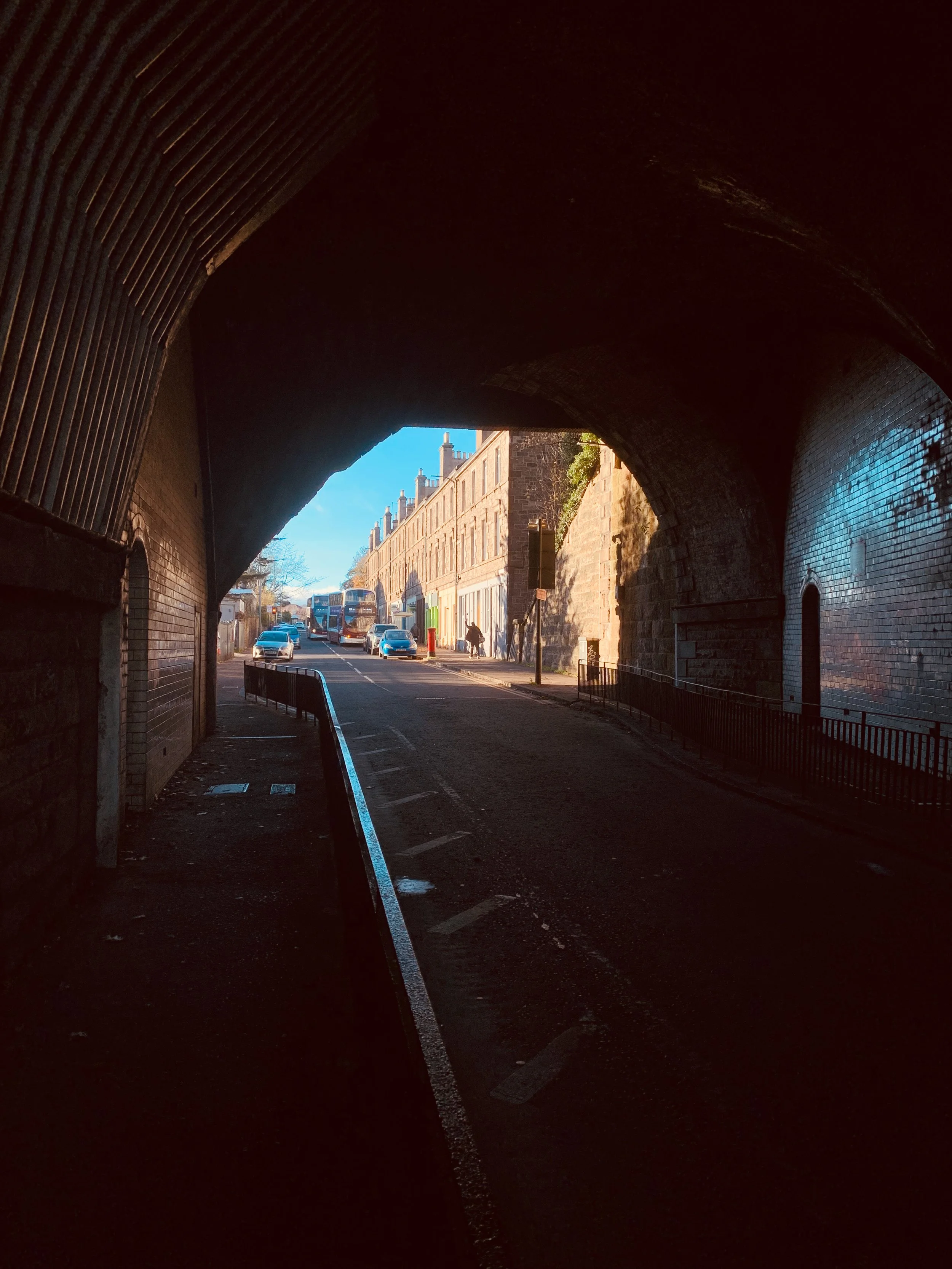
I’ve been thinking about whether a walk can hold an inner map.
Not the kind of map that tells you where the Asda is, or which road folds into which roundabout—but the quieter cartography: what changes in you as you move, what becomes visible only once you’ve walked through it.
Lately, I keep returning to Attar’s Conference of the Birds. The birds travel looking for the Simurgh, and the journey is told as a passage through valleys—states of being. It’s not a story about destination as much as it is about refinement: the long work of shedding certainty, learning to listen, arriving at something that was there all along.
My Portobello route has its own valleys.
It begins at The Jewel—noise, junction logic, the modern insistence of movement. A place that feels designed to keep you passing through. Then the route threads toward Brunstane, where water runs nearby in hidden lines, and the city softens into green seams. A station appears like a hinge: people arriving, leaving, returning, not always naming what they’ve carried back with them.
On Milton Road, the graveyard is the point I cannot pretend is neutral. My grandmother is buried there. And suddenly the walk isn’t only a walk. It is a form of visitation. A pause in the city’s rhythm where time stops behaving politely. Grief is a landmark that doesn’t show up on most maps, but it quietly reorganises everything.
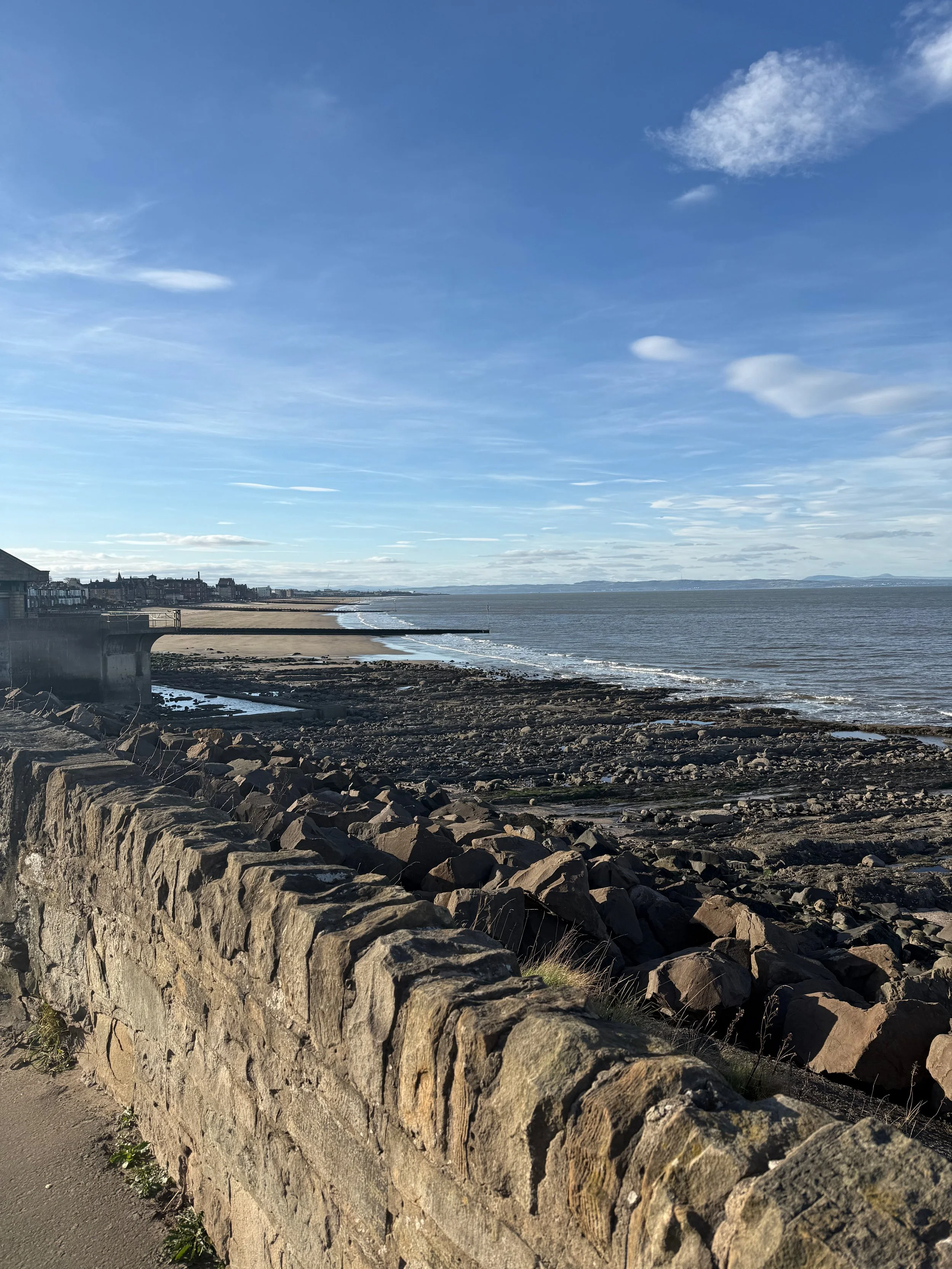
Then the promenade. The horizon arrives. The sea doesn’t explain itself—it just holds its distance, and in that distance something in the mind loosens. At Joppa Rocks, the time-scale breaks open again: deep stone, older than our narratives, older than our urgency. You don’t stand there and feel important. You stand there and feel correctly sized.
I’m not trying to illustrate Attar. I’m using him as a framework: a way to name the inner shifts that happen along an ordinary route. A way to treat walking as research, and mapping as something more than streets and edges.
Perhaps that’s what I’m trying to make in cloth: a cartography where the visible and the invisible sit together—route and weather, infrastructure and memory, sea and burial ground, the city and what it asks from the body.
Map legend (for the work):
Valley I — Departure (The Jewel)
Valley II — The Hidden Water (Brunstane / burns)
Valley III — The Hinge (Station)
Valley IV — Remembrance (Portobello Cemetery)
Valley V — Horizon (Promenade)
Valley VI — Deep Time (Joppa Rocks)
Return — Same route, altered body
What might become cloth:
A faint printed grid; the route stitched as a single continuous line; small breaks at each “valley”—like breath-marks—where weather and memory interrupt the logic of the map.
