|
$$PLAIN_TEXT_PREVIEW$$
Woven in the Hindukush: Geeve gatherings of Chitrali shu By Adil Iqbal
|
|
In December 2022, as part of the EMKP project, Adil Iqbal and his team visited the valley of Garam Chashma in Chitral, northwest Pakistan, to document the preparation of wool for the weaving of the renowned Chitrali shu fabric. In the past, the women artisans worked together to sort wool, a practice that has ceased in recent times. On the last day of their field visit, the artisans surprised Adil and his team with a special gift. They gathered under one roof to demonstrate how a Geeve would have been practiced in the past. The following narration is an ode to Geeve gatherings, a place of solace for women artisans of Chitral.
|
|
|
|
Group of women teasing raw wool in Royee village. Photo credit Feroza Gulzar |
|
|
|
In the heart of Chitral’s winter landscape in North-West Pakistan, the vibrant art of shu-making comes alive. Each stage of wool processing in the making of the shu is not just an action, it is a narrative, eloquently shared by different shu makers of the community. A gentle glow emanating from a lantern lit the aged walls of a dwelling in Royee, a remote village in Garam Chashma, where nine or ten young women were gathered. In silent, sacred agreement, the women had joined forces with the elder matriarchs of the village, embarking on an age-old tradition:‘Geeve’, the ceremonial sorting of wool. The night was long, often stretching until the quietest hours of twelve or one in the morning. Yet, even in the midst of such toil, there was magic.
|
|
|
|
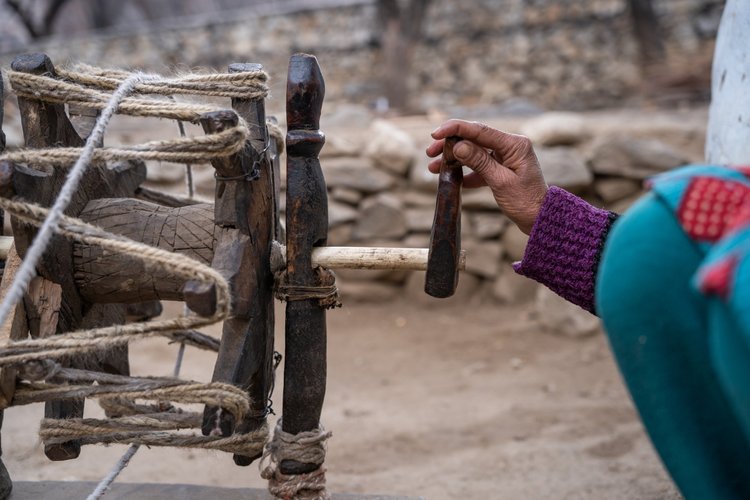
A local artisan spinning a traditional spinning wheel in Royee village. Photo credit Feroza Gulzar |
|
|
|
With each gathering, the older women would unravel tales as intricate and fascinating as the wool they carded. Their stories, passed down through generations, became the backdrop against which the women worked. These narratives of love, sorrow, adventure, and mystery wove through the night, binding each woman to the traditions of their foremothers and the symphony of shared work.
|
|
|
|
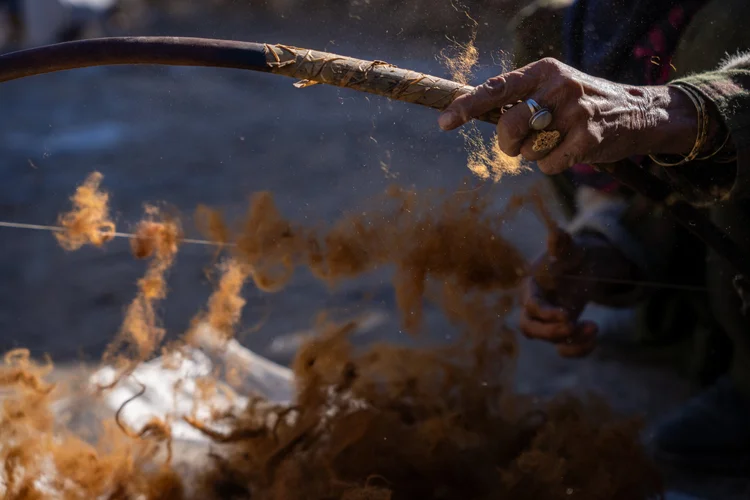
A local artisan carding the wool using a carding bow in Royee village. Photo credit Feroza Gulzar |
|
|
|
But not all nights were filled with just stories and camaraderie. Some brought with them omens, both good and ill. When a woman showed exceptional skill in sorting and carding wool, she was hailed as 'capable', a beacon of good fortune for the entire village. The older women bestowed upon her the title of a 'capable daughter' as a mark of honor. Conversely, the appearance of certain individuals wasn't as welcome. Whispers would float among the group, suggesting that their task's slow progress was due to a particular woman's wickedness. "Because of her, the wool won't separate," they'd murmur. Her presence became synonymous with bad luck, a curse in the otherwise harmonious night. As young women mastered the art of carding, teasing and spinning, their mothers added another layer of mysticism. With deep-rooted belief, they would tie an amulet, spinning it anti-clockwise, ensuring protection, luck, and perhaps a hint of magic for their daughters.
|
|
|
|
Group of artisan sorting wool and preparing chai in Royee village. Photo credit Feroza Gulzar |
|
|
|
However, wool carding was not easy. Sometimes, the continuous sorting numbed their fingers, turning their nails blue and making them brittle enough to fall off. Yet, the shu makers found joy in the shared rhythm. In a delightful mimicry, the younger women would often imitate the techniques of the most skilled among the elder women, striving to master the art passed down through generations. Since men were not allowed in the Geeve, it gave the women more freedom and space to express themselves. Geeve evenings weren't just about diligent work; they were also about gastronomic delights. The aroma of boiling black beans from Gobor occasionally complemented by the sweet scent of shupa halwa filled the air. Geeve gatherings celebrated the confluence of craft-making, play and ritual.
|
|
|
|
A local artisan teasing wool in Royee village. Photo credit Feroza Gulzar |
|
|
|
However, as seasons changed, the winds of time eroded this tradition. Geeve, once the beacon of unity and collective creativity, started fading into the annals of history. Yet, its memory remains indelible in the hearts of older artisans, for whom the love for shu-making is so profound that they wish to carry the wool even to their graves.
|
|
|
|
Group of artisan teasing wool during Geeve gathering in Royee village. Photo credit Feroza Gulzar |
|
|
|
“The disappearance of Geeve represents a profound cultural shift. What once was a vibrant tradition of community support has faded into a silent pursuit of individual goals. It's as if we've lost the thread that used to connect us” Mulkhon (local artisan) from Royee village
|
|
PERISTAN a tapestry, woven of wild dreams no rules, no themes, where beauty blooms in surprise crafted with love, whispered in art's embrace
|
|
Website Instagram Facebook info@twillingtweeds.com
|
|
|
|