|
$$PLAIN_TEXT_PREVIEW$$
Cultural Kinship: An Encounter Between Chitrali and Uyghur Poets By Adil Iqbal
|
|
In this poignant short story, Chitrali poet Mohammad Syar meets Yousuf, a fellow poet from Kashgar, sparking an unexpected friendship under an ancient chinar tree. As they share stories of their homelands shaped by political upheaval, they discover a deep cultural connection. Their bond deepens during a moving visit to the local mosque, where Yousuf finds a moment of profound peace. This narrative beautifully illustrates the power of empathy and shared heritage to bridge worlds and heal spirits, inviting readers into a heartfelt exploration of resilience and kinship.
|
|
Mohammad Syar, a poet from the village of Goldor in Chitral, was returning home when he noticed an elderly man in an emerald green cap resting under an ancient Chinar tree. Compelled by a sense of kinship, Syar approached the man with a warm smile. "Salam brar—peace be upon you, brother," he greeted. The stranger looked up, returning the smile with a nod. "Wa ʿalaykumu -salam,"(and upon you be peace) he replied, his voice marked by a gentle accent. "Are you from Chitral?" Syar asked, intrigued by the man's distinct appearance. "No," the man said, shaking his head slightly. "I am from Kashgar. My name is Yousuf." Syar's eyes widened with interest. "Kashgar? That city of traders and poets! You are far from home, brother." Yousuf's gaze held a mixture of sadness and relief. "Indeed, I am lost, and it is no longer safe for me to return. Your village reminds me of my own." Moved by the man's plight, Syar invited Yousuf to his home, promising a place of safety and warmth. As they walked, the poets exchanged stories of their homelands, weaving a tapestry of shared history and mutual understanding that transcended borders.
|
|
"Chitral was once called 'little Kashgar' by our elders," Syar revealed as they navigated the winding paths of his village. "They travelled often between our regions, exchanging goods and stories." Yousuf nodded, his eyes reflecting a deep melancholy. "Kashgar, as you speak of it, no longer exists. It has been swallowed by changes, by politics and strife. There is a cultural genocide on the Uyghurs by China. We, its people, are left scattered." Syar listened, his heart heavy. "We too face our challenges here. Our youth are growing distant from our traditions. Yet, we are fortunate still to have our land, language and our freedoms."
|
|
Yousuf's family had all immigrated abroad since the crackdown on Uyghur people began, and both his son and daughter had been missing for over eight months. His grandchildren had been put in an orphanage. As Yousuf grieved for his family and the loss of his culture, Syar tried to console him. "Ma shireen xjaan (my sweetheart)," he said, placing his hand on Yousuf's shoulder, "inshallah (god willing), things will get better." At this, Yousuf looked up and smiled, feeling something he had not felt in months. "Inshallah," he repeated, after the brutal crackdown by Han Chinese, all religious phrases, symbols, and practices were prohibited by the Chinese. “I feel safe here".
|
|
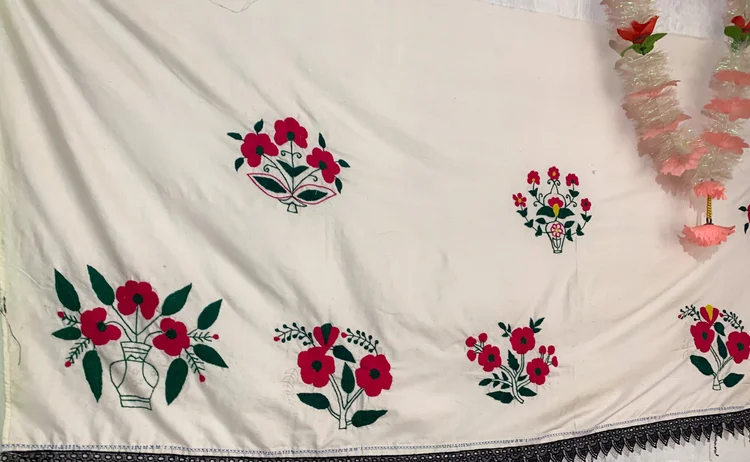
The depth of their conversation led them to Syar's home, where the aroma of freshly baked Zolai bret (Walnut bread) and the sound of children playing filled the air. As they entered the mehman khanna (Guest room), Yousuf's eyes were immediately drawn to a delicately embroidered mantelpiece cloth that reminded him of a similar fabric he had seen in his ancestral home in Yarkand. Syar explained that the material was called panpush and had been made by his eldest daughter Gulestan, a skilled embroiderer. Gulestan, emerged with trays of trup chai (salted tea) and bread. "Welcome, sir," she said to Yousuf, her smile warm and inviting. Yousuf, touched by the familiarity of the customs, reached into his bag and presented Gulestan with a small, embroidered handkerchief on atlas silk, intricately detailed in the traditional Uyghur style. "Peace be upon you," it read.
|
|
The afternoon waned as they discussed poetry, culture, and the cruel hand of politics that had displaced so many. As the call to prayer rang out from the nearby Jang Bazaar mosque, Yousuf's eyes welled with tears. Months had passed since he had heard the Azan; it stirred a deep longing in him. Syar, understanding the significance, gently placed a hand on Yousuf's shoulder. "Come, let us pray together." At the mosque, Yousuf prayed with a fervour born of both loss and gratitude. When they emerged, the setting sun painted the sky in hues of gold and crimson. "I feel a peace I have not known in months," Yousuf confessed as they walked back. "That is the gift of this place," Syar replied. "Here, you are always welcome."
|
|
As the evening drew to a close, Yousuf prepared to continue his journey, his spirit lifted but his path uncertain. Syar offered him a Shoka, a traditional woollen coat, to guard against the cold. Yousuf accepted, touched by the kindness and the familiar feel of the garment. Syar's daughter Gulestan rushed into the kitchen, her hands busy packing dried apricots, mulberries, and walnuts for Yousuf's journey. Yousuf accepted the provisions with gratitude and expressed his thanks for her kindness. They parted with a promise from Syar. "This is not goodbye, my brother. It's merely until we meet again."
|
|
Yousuf left Chitral with a heavy heart lightened by the unexpected kinship he had found. And as Syar watched him disappear into the twilight, he felt a renewed sense of purpose—a commitment to extending his hand to those in need, united by poetry and shared humanity. The wind picked up as night fell over Goldor, carrying with it the promise of future connections, of hope and resilience in a world that often seemed too vast and indifferent. In his home, surrounded by the laughter of his family and the lingering presence of his new friend, Syar penned a poem about the bridging of worlds, a testament to the enduring spirit of kinship found in the most unexpected places.
|
|
PERISTAN a tapestry, woven of wild dreams no rules, no themes, where beauty blooms in surprise crafted with love, whispered in art's embrace
|
|
Website Instagram Facebook info@twillingtweeds.com
|
|
|
|